
Video surveillance has evolved far beyond recording footage for later review. Modern AI-powered surveillance systems can analyze video in real time, identify specific events, and help security teams respond more efficiently.
However, not every AI feature delivers the same value in every environment. For businesses, system integrators, and security professionals, the key is understanding which capabilities address actual security challenges and how they contribute to more effective monitoring.
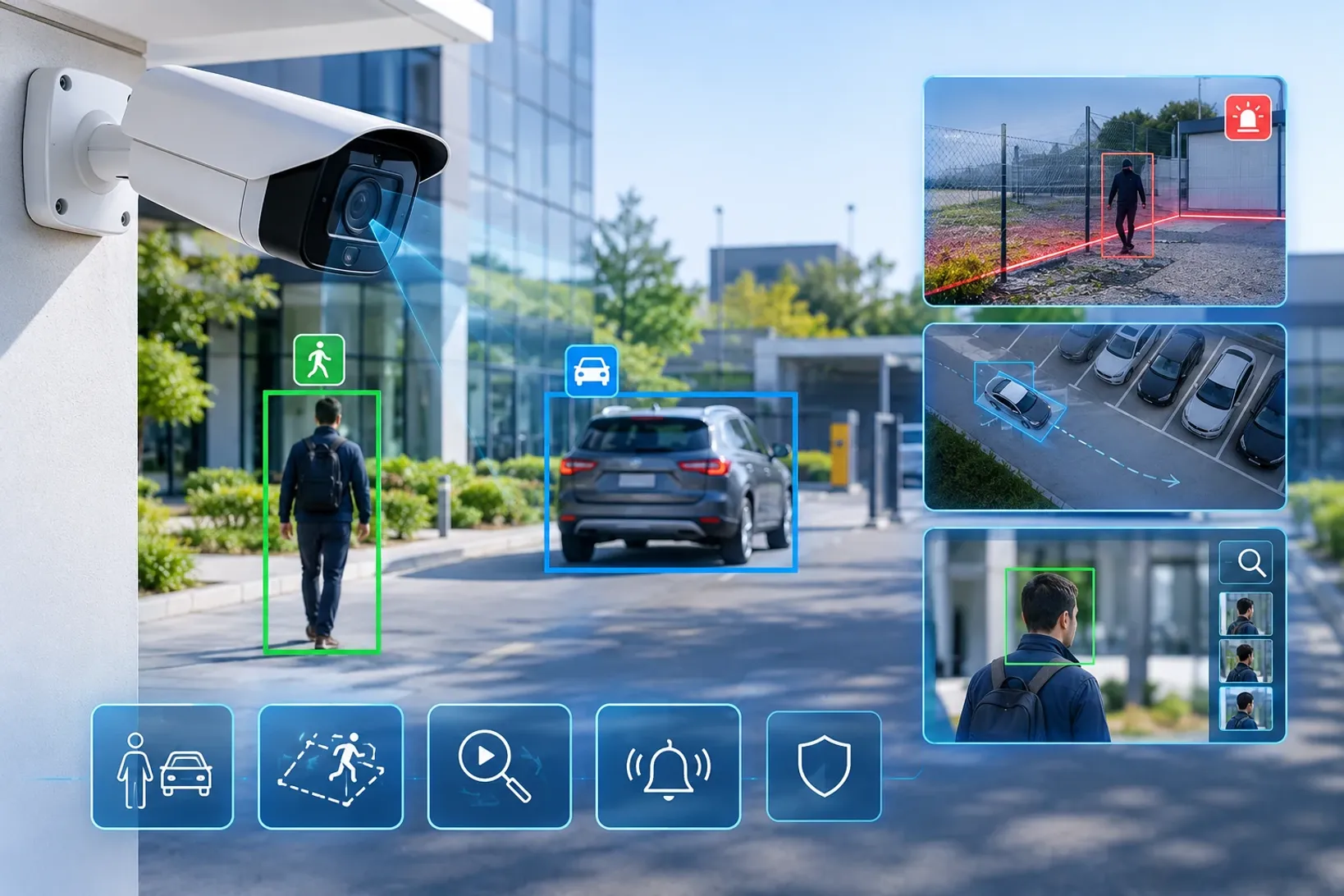
One of the most practical features is human and vehicle detection. Traditional motion detection can trigger alerts whenever something moves within a camera’s field of view, including trees, passing animals, or changing light conditions. AI-based detection can distinguish people and vehicles from many other moving objects, helping reduce irrelevant notifications and allowing security personnel to focus on events that require attention. This is particularly useful for commercial buildings, warehouses, parking areas, and industrial facilities where continuous monitoring is essential.
Another valuable capability is intelligent perimeter protection. Features such as line-crossing detection and intrusion detection can identify when a person or vehicle crosses a virtual boundary or enters a restricted zone. Instead of relying entirely on security personnel to watch multiple camera feeds, organizations can configure alerts around specific areas, such as warehouse entrances, equipment storage zones, loading bays, or construction site boundaries. Proper camera placement and accurate configuration are essential to ensure reliable detection and minimize false alarms.
AI-powered video search and tracking can also improve security operations. When an incident occurs, locating the relevant footage across hours of recordings and multiple cameras can be time-consuming. Depending on the system, intelligent search tools can help operators find video containing particular types of objects or events more quickly. Some cameras also support target tracking, helping maintain visibility of a moving person or vehicle within the camera’s capabilities. These functions can simplify incident investigation, support internal security reviews, and reduce the time required to locate important evidence.
Real-time alerts and active deterrence provide another practical advantage. When a supported detection rule is triggered, a surveillance system can notify designated personnel or activate configured responses, such as a warning light or audible alarm. Some cameras combine intelligent detection with built-in speakers, microphones, or other deterrence features. These capabilities can be useful at restricted entrances, remote facilities, and locations where immediate intervention is important. However, automated responses should be configured carefully to avoid unnecessary disturbances and ensure that alerts reach the appropriate people.
The effectiveness of AI surveillance also depends on selecting features that match the environment. An office building may benefit most from monitoring restricted rooms and identifying unauthorized entry, while a logistics facility may prioritize vehicle movement, loading areas, and perimeter protection. Construction sites and remote infrastructure locations may require reliable outdoor detection under changing weather and lighting conditions.
In each case, the objective should be to select capabilities that address specific risks rather than pay for advanced functions that the organization may never use.
Despite its advantages, AI video surveillance is not entirely autonomous or error-free. Detection accuracy can be affected by camera angle, image quality, insufficient lighting, obstructions, weather, and incorrect configuration. Compatibility between cameras, network video recorders (NVRs), and video management software should also be verified, as some analytics functions may require specific hardware or software support.
Organizations should additionally consider data protection requirements, access permissions, and video retention policies when deploying intelligent monitoring systems.
Ultimately, the value of AI video surveillance lies in how effectively it solves real security problems. Human and vehicle detection can help reduce irrelevant alerts, perimeter protection can highlight potentially unauthorized activity, intelligent search can accelerate investigations, and automated notifications can support faster responses.
For businesses and security integrators, evaluating these features against actual site requirements is the most reliable way to build a surveillance system that delivers practical benefits, improves operational efficiency, and supports long-term security objectives.