
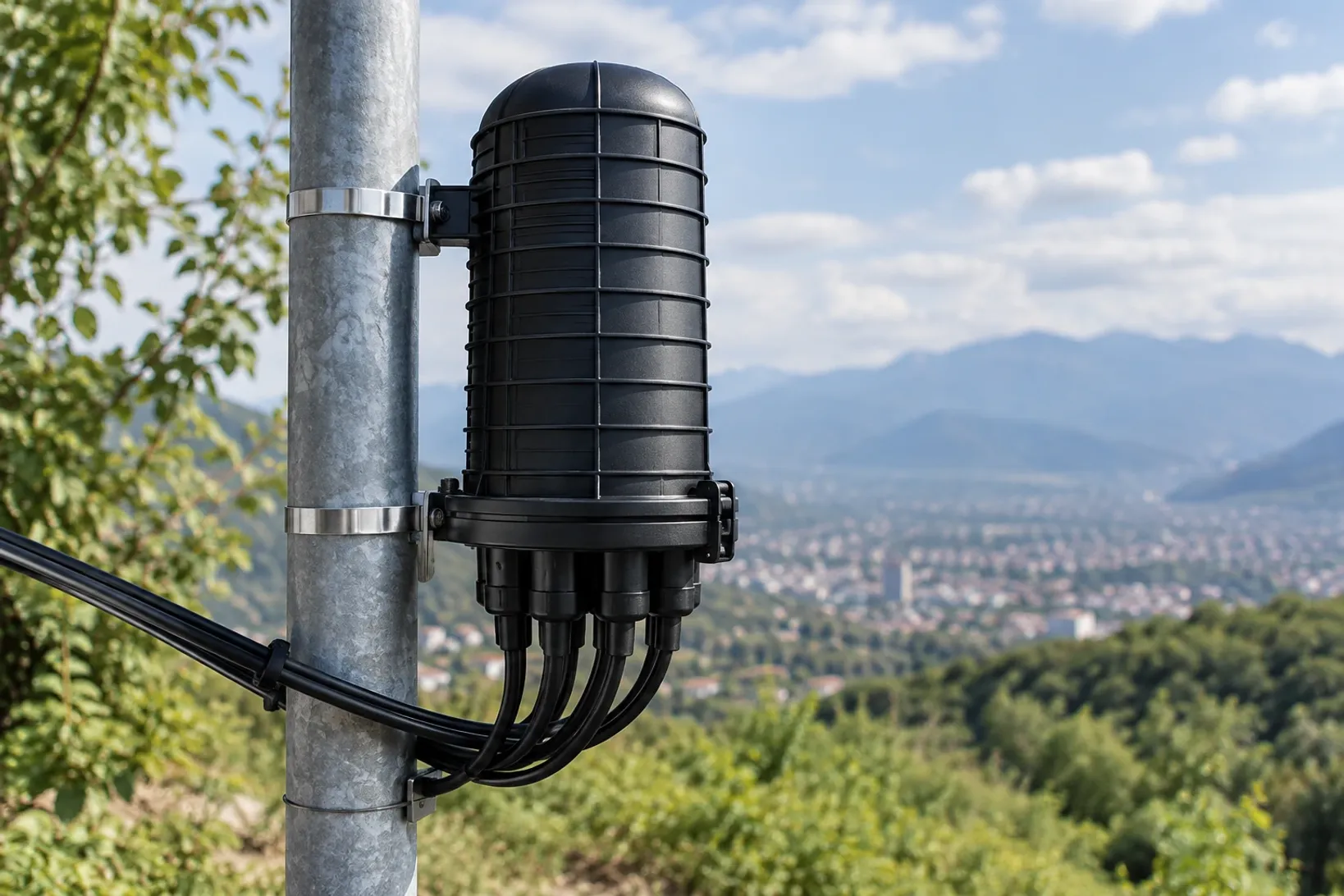
When designing a reliable fiber optic network, choosing the right cable and splicing equipment is only part of the job. One component that is often overlooked—but plays a critical role in long-term network reliability—is the fiber optic splice closure. A splice closure protects fiber splices and cable connections from moisture, dust, mechanical stress, temperature fluctuations, and other environmental factors. Among the most widely used designs are dome and inline fiber optic closures, and while both serve the same fundamental purpose, they are designed for different installation requirements.
A dome fiber optic closure typically has a vertical, dome-shaped enclosure with cables entering through the base. Inside, splice trays provide organized fiber management and protection for the splices. This design is particularly suitable for outdoor applications, including aerial, pole, tower, and underground installations. Dome closures are often preferred when several cables need to be managed within a single enclosure or when the network includes branching and distribution points. Their construction can provide strong environmental protection, while the internal layout allows technicians to organize a relatively large number of fibers in a compact space. For FTTH and distribution networks, where one cable may need to branch into several directions, a dome closure can be a practical solution.
An inline fiber optic closure, sometimes referred to as a horizontal closure, has a more elongated design, with cables generally entering from opposite ends. This makes it particularly well suited to straight-through fiber routes, where one cable continues to another through the splice point. Inline closures are commonly used in underground networks, ducts, backbone routes, and cable repair applications. Their linear internal arrangement can make fiber routing straightforward and provide convenient access to the splice area when maintenance or repairs are required.
The main difference between these two types is therefore not simply their physical shape—it is how effectively each design fits the network architecture. If the installation involves multiple cable entries, branching, aerial deployment, or a distribution point where several fibers need to be managed, a dome closure may be the more appropriate choice. If the installation involves a continuous cable route, underground infrastructure, or a straight-through splice between two cable sections, an inline closure may offer a more practical configuration.
However, the decision should not be based on installation type alone. Fiber capacity, cable diameter, number of cable entries, sealing method, environmental protection, splice tray design, cable fixation, available installation space, and future expansion requirements should all be considered before selecting a closure. For outdoor networks in particular, reliable sealing is essential because even a small amount of moisture entering the enclosure over time can affect splice performance and contribute to long-term network failures. The closure should also provide proper fiber routing and bending-radius management to prevent unnecessary stress on the fibers.
Future scalability is another important consideration. A closure may meet today's requirements but become a limitation when additional cables or fibers need to be added. Choosing a model with sufficient spare capacity can make future network expansion and maintenance significantly easier and reduce the need for additional installation work.
Ultimately, there is no universal winner between dome and inline fiber optic closures. The right choice depends on the network architecture, installation environment, fiber capacity, cable configuration, and long-term maintenance requirements. Dome closures are generally well suited to branching, distribution, and aerial applications, while inline closures are often a strong choice for straight-through connections, underground routes, ducts, and backbone infrastructure. In both cases, the closure is much more than a protective box—it is a critical part of the physical infrastructure that keeps fiber splices protected and the network operating reliably over time.
When selecting a fiber optic closure, the best approach is to start with the network requirements and then choose the closure that provides the right combination of protection, capacity, accessibility, and scalability. A properly selected and installed closure can significantly reduce environmental and mechanical risks and help ensure that the fiber network remains stable and maintainable for years to come.