
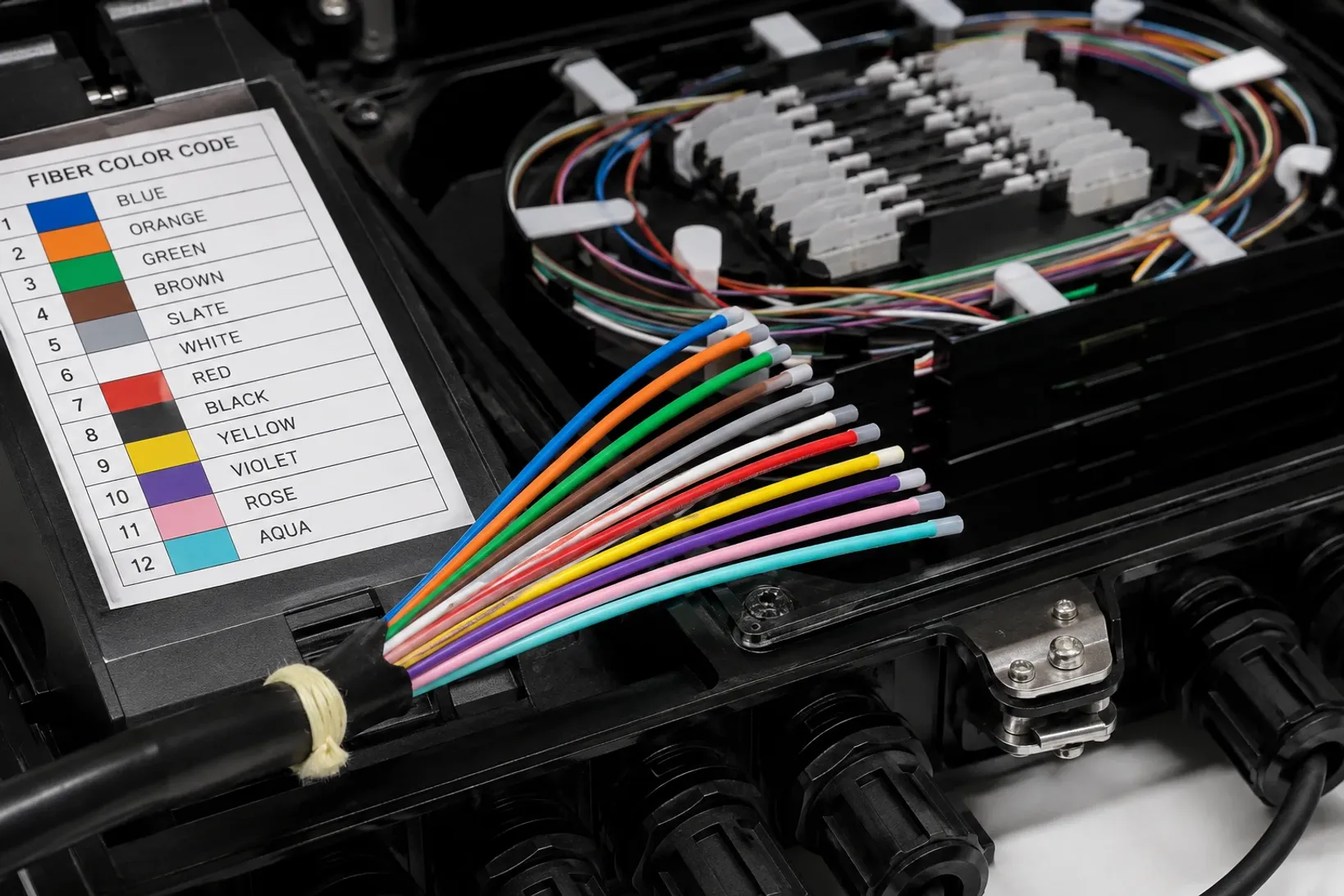
At first glance, the colorful fibers inside a fiber optic cable may seem like nothing more than a way to make the cable look organized.
In reality, these colors follow a standardized identification system that plays a crucial role in every stage of a fiber optic network—from installation and splicing to testing, maintenance, and troubleshooting. Without fiber color codes, identifying the correct fiber in a cable containing dozens or even hundreds of fibers would be a time-consuming process, increasing the risk of errors and service interruptions.
Most fiber optic cables follow a standard sequence of 12 colors: Blue, Orange, Green, Brown, Slate (Gray), White, Red, Black, Yellow, Violet, Rose (Pink), and Aqua. In larger cables, these colors repeat within different buffer tubes, while the tubes themselves are also color-coded to make identification even easier. For example, a 144-fiber cable is commonly made up of 12 color-coded buffer tubes, each containing 12 fibers arranged in the same color sequence. This structured organization allows technicians to quickly locate the exact fiber they need without confusion, making installation faster and future maintenance much more efficient.
Following standardized color codes significantly reduces the chance of connecting or splicing the wrong fiber. In telecom and FTTH networks, a single incorrect splice can disrupt service for multiple customers, delay projects, and increase repair costs. Color coding provides a common language for technicians, ensuring that everyone involved in the project can identify fibers consistently, regardless of who performed the original installation. It also simplifies documentation, making it easier to trace connections and troubleshoot problems years after a network has been deployed.
Although the 12-color sequence is widely recognized across the telecommunications industry, there can be slight variations depending on the manufacturer or specific regional standards. For this reason, technicians should always review the cable manufacturer's documentation before starting installation or maintenance rather than assuming every cable follows exactly the same arrangement. Paying attention to both the buffer tube colors and the individual fiber colors is equally important, as confusing the two is one of the most common causes of installation mistakes.
Proper fiber identification goes hand in hand with good labeling and documentation practices. Even when color codes are followed correctly, failing to label splices or record fiber assignments can make future maintenance much more difficult. Clear documentation helps technicians quickly locate faults, perform upgrades, and minimize downtime without unnecessary testing or guesswork.
Understanding fiber cable color codes may seem like a small detail, but it is one of the foundations of a reliable fiber optic network. A standardized color system helps reduce installation errors, speeds up troubleshooting, improves maintenance efficiency, and contributes to the long-term reliability of telecommunications infrastructure.