
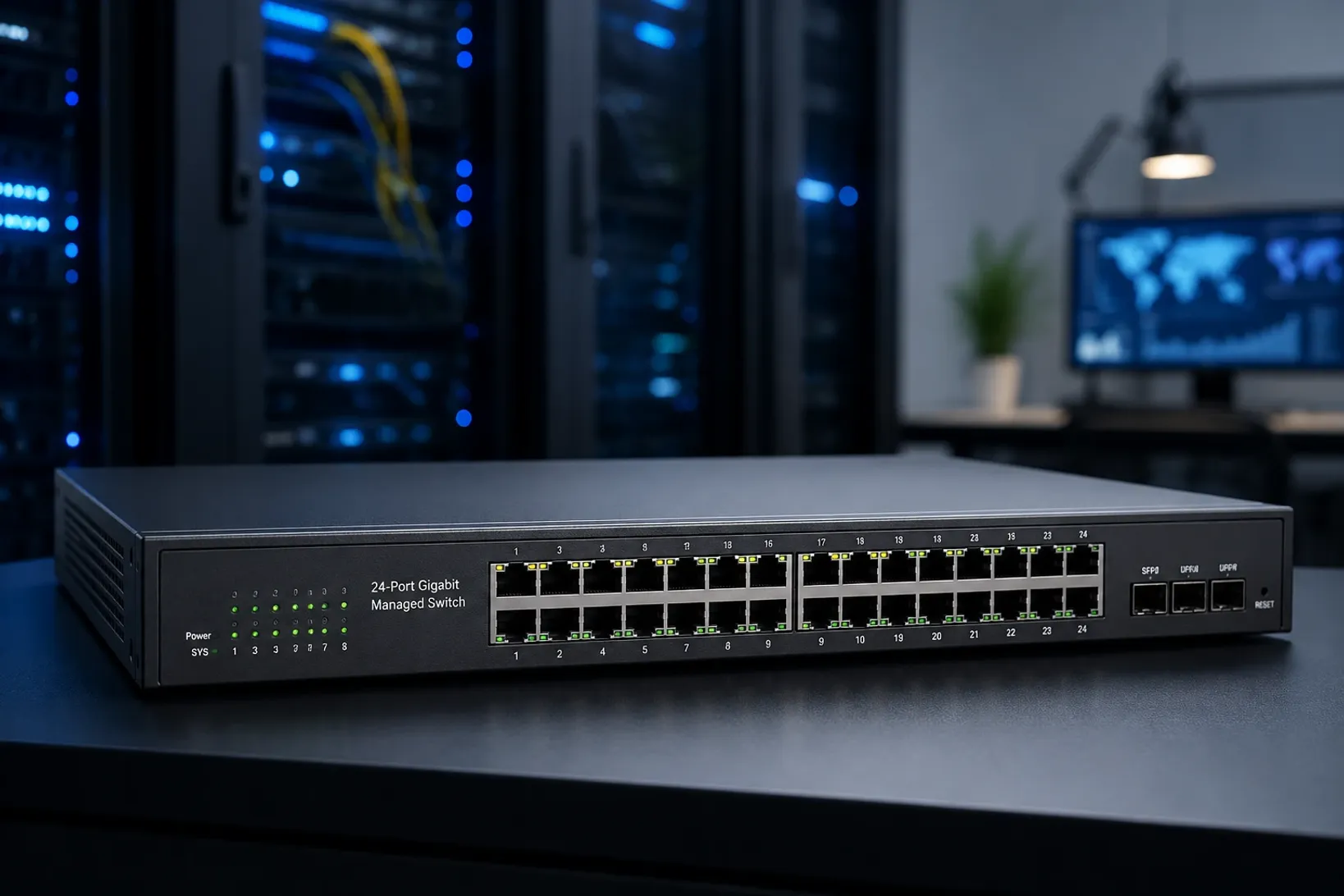
In today’s business environment, network performance has a direct impact on productivity, communication, and overall operational efficiency. Nearly every modern company depends on stable connectivity for daily tasks such as file sharing, cloud services, video conferencing, surveillance systems, online collaboration, and smart office technologies. Behind all of these processes is a critical component that often goes unnoticed — the network switch.
A network switch is responsible for connecting devices within the same network and managing how data moves between them. Unlike older networking methods that broadcast information to every connected device, switches intelligently send data only to its intended destination. This allows businesses to maintain faster, more organized, and more reliable communication between computers, servers, printers, IP phones, access points, and other connected systems.
As businesses grow, network demands increase significantly. More employees, more connected devices, and greater reliance on cloud-based applications create heavier traffic within the infrastructure. Without a reliable switching solution, networks can quickly become congested, leading to slow file transfers, interrupted video meetings, unstable internet connections, and delays in communication. These issues not only affect workflow efficiency but can also impact customer experience and business performance.
Modern network switches help optimize traffic flow and reduce bottlenecks by allowing multiple devices to communicate simultaneously without unnecessary collisions in the network. This creates smoother data transmission and improves overall speed and stability. For companies that rely heavily on real-time applications such as VoIP communication, online meetings, cloud platforms, and security systems, stable network performance becomes essential for maintaining productivity throughout the workday.
Managed switches provide even greater advantages for businesses by offering advanced traffic management and monitoring capabilities. Features such as VLAN segmentation, Quality of Service (QoS), traffic prioritization, and real-time network monitoring allow organizations to control bandwidth usage more effectively and prioritize critical applications. This helps ensure that important systems continue operating smoothly even during periods of heavy network activity.
Network switches also play an important role in cybersecurity and infrastructure management. Businesses can separate departments, guest networks, surveillance systems, and sensitive devices into different network segments, improving both security and network efficiency. By isolating systems and controlling traffic flow, organizations reduce unnecessary communication between devices and create a more secure internal environment.
Scalability is another major reason why switching infrastructure matters. As businesses expand, their networks must support additional employees, devices, servers, IP cameras, and wireless access points. Modern switches are designed to grow alongside business needs, allowing companies to expand their infrastructure without completely rebuilding their network systems. This flexibility is especially important for organizations planning long-term growth or adopting modern digital technologies.
Power over Ethernet (PoE) switches have also become increasingly valuable in modern business environments. PoE technology allows both power and data to travel through a single Ethernet cable, simplifying installations and reducing cabling requirements. This solution is widely used for IP cameras, Wi-Fi access points, VoIP phones, access control systems, and smart building technologies. For businesses, this means cleaner infrastructure, easier maintenance, and lower installation costs.
As technologies such as artificial intelligence, cloud computing, IoT systems, and high-speed wireless networks continue evolving, the importance of strong networking infrastructure becomes even greater. Outdated switches and weak network architecture can create performance limitations that slow down operations and reduce efficiency. Investing in modern switching solutions helps businesses prepare for future technological demands while maintaining stable and reliable connectivity.
Although network switches may not always receive the same attention as other technologies, they remain one of the most important foundations of modern business infrastructure. A reliable switching solution improves communication, supports productivity, enhances security, reduces downtime, and allows organizations to scale more efficiently. In a world where businesses depend heavily on fast and stable connectivity, the quality of network infrastructure can directly influence long-term success.