
Access control is no longer limited to physical keys, RFID cards, or PIN codes. As businesses, residential complexes, hotels, industrial facilities, and smart buildings look for faster, more convenient, and more flexible ways to manage entry, touchless access control is becoming an increasingly important part of modern security infrastructure.
Touchless access control allows users to authenticate without physically touching a reader, keypad, or biometric device. Depending on the requirements of the facility, this can include mobile credentials through Bluetooth or NFC, QR codes, facial recognition, RFID, or other biometric technologies. The key advantage is flexibility: instead of relying on a single authentication method, modern systems can combine several technologies and assign them according to the user's role and access requirements.
One of the main reasons businesses are moving toward touchless solutions is convenience. Employees can use their smartphones as digital credentials instead of carrying physical access cards, while Bluetooth-based systems can provide hands-free authentication in suitable environments. NFC can provide a quick and familiar tap-to-authenticate experience, while QR codes are particularly useful for visitors, contractors, and temporary access.
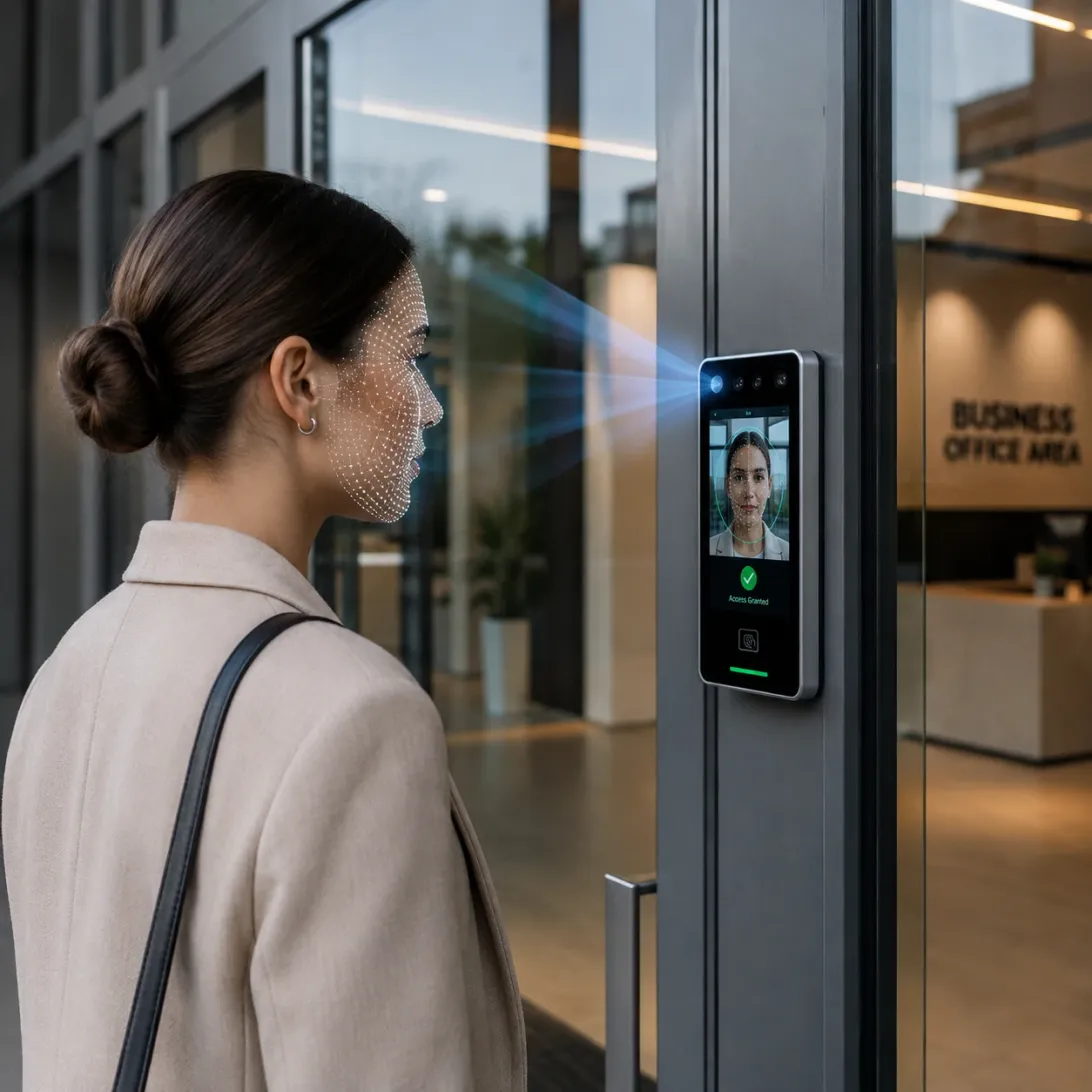
Facial recognition can provide another contact-free option where biometric authentication is appropriate.
However, touchless access control is not simply about making entry more convenient. From an engineering perspective, the real value comes from how the access-control system is designed and integrated into the wider security infrastructure.
A modern system can connect access control with video surveillance, intercoms, elevators, parking systems, visitor management, and other building technologies. For example, when an employee authenticates at a door, the system can verify the credential, unlock the door, record the event, and associate the access event with video footage from the relevant camera. This creates a much more complete security environment than an isolated door reader.
Another important advantage is centralized management. Modern access-control platforms can allow administrators to create, modify, and revoke credentials, define access schedules, manage different security zones, and monitor access events from a central platform. This becomes particularly valuable for organizations with multiple entrances, buildings, or locations. Instead of physically collecting a card when an employee leaves the company, administrators can simply revoke the corresponding digital credential or access permission.
At the same time, touchless does not automatically mean more secure. This is one of the most important considerations when selecting an access-control solution. The authentication technology is only one part of the system. It is also necessary to consider how credentials are protected, how user data is handled, whether the system can operate during network interruptions, where access events are stored, and what happens during a power failure. Fail-safe and fail-secure requirements should also be considered for each door according to the purpose of the facility.
Integration and scalability are equally important. A system that works well for 50 users and five doors may not be suitable for an organization with thousands of users and hundreds of access points. Network architecture, controller capacity, communication protocols, power supply, data storage, and centralized management should therefore be considered before equipment is selected.
It is also unlikely that one authentication method will replace every other method. Different environments have different requirements. An office may prefer mobile credentials, an industrial facility may continue using RFID cards, a visitor may receive a temporary QR code, while a high-security area may require biometric authentication or multiple authentication factors. For this reason, the future of access control is not necessarily completely cardless — it is more likely to be multi-credential and adaptable.
From our perspective as security-system engineers and integrators, the most important principle is simple: don't choose an access-control device first and try to build the system around it. Start with the requirements of the facility, understand the security risks, user flow, network infrastructure, and integration requirements, and then select the appropriate technology.
Touchless access control is therefore much more than a trend toward contact-free entry. It represents a broader shift toward digital credentials, connected security systems, centralized management, and more flexible authentication. The goal is not simply to open a door without touching a reader. The goal is to create an access-control system that is secure, reliable, scalable, and convenient for the people who use it every day.