
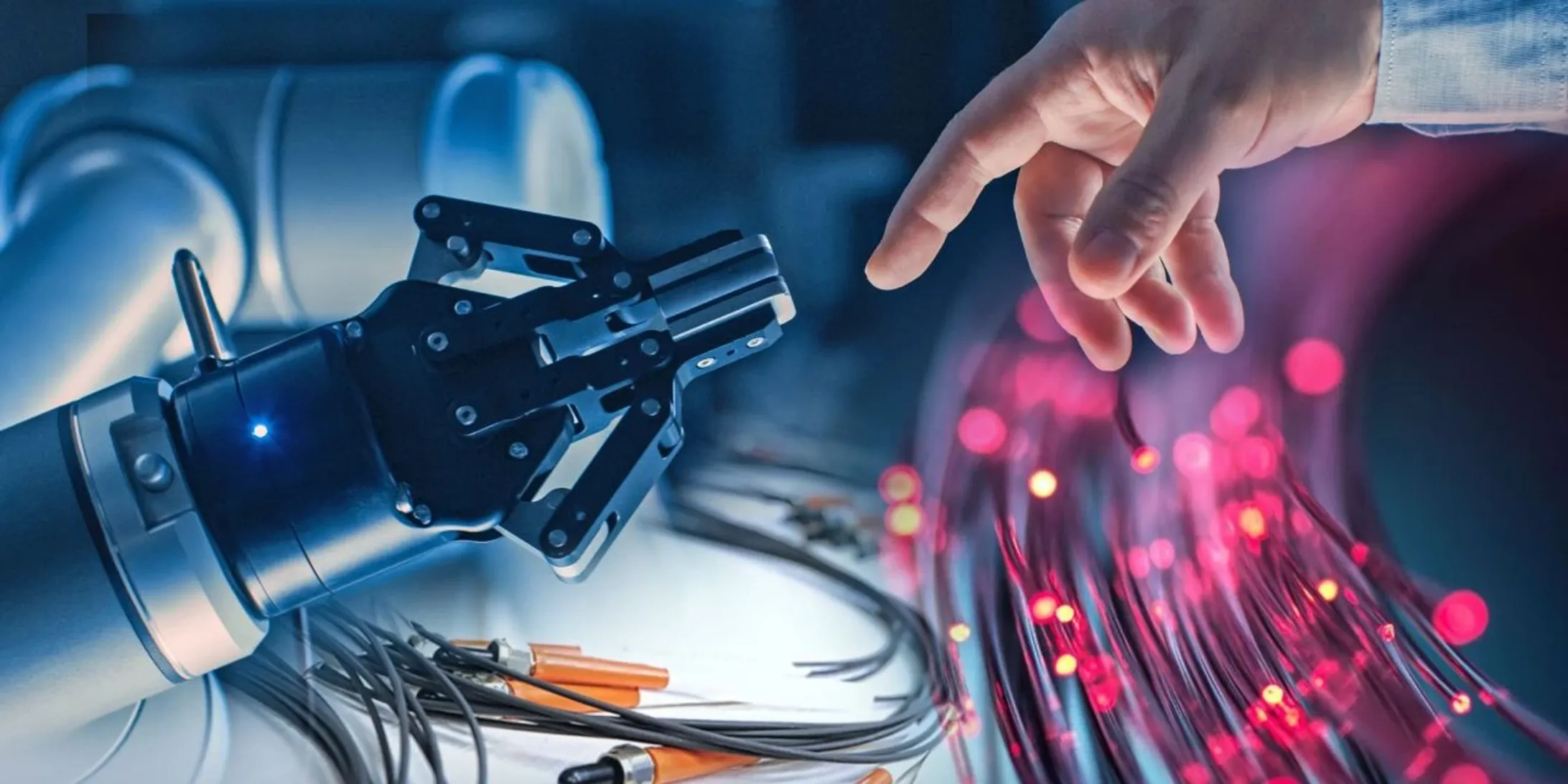
Industrial automation is evolving rapidly, and modern factories are no longer dependent only on fast machines or robotic arms. Every element of the production environment—from sensors and controllers to monitoring systems—requires stable, interference-free, and secure connectivity. This demand has led to the emergence of Fiber-to-the-Machine (FTTM), a concept where fiber optic cabling does not end at the network backbone but extends directly to machines, robots, and control units.
FTTM is no longer a future concept; it is the infrastructure many leading manufacturers are already adopting to improve efficiency, reduce downtime, and enhance real-time control across the production line.
The main driver behind FTTM is the need for noise-immune communication. Industrial sites are filled with electromagnetic interference generated by motors, drives, inverters, and high-voltage equipment. Copper cables are highly vulnerable in such conditions.
Fiber optics, however, are immune to EMI and provide a clean, stable signal even in environments with heavy industrial noise. At the same time, fiber delivers significantly higher bandwidth and lower latency. This is essential for systems such as vision-based inspection tools, high-precision CNC machines, automated guided vehicles (AGVs), mobile robots, and advanced sensor networks, all of which rely on the fast exchange of large amounts of data. Fiber also supports long-distance communication without signal loss, which is critical in large factories where copper’s 90-meter limitation becomes a major bottleneck. With fiber, equipment can be interconnected across hundreds of meters or even kilometers with consistent performance.
Another important advantage is safety and security. Because fiber does not carry electrical current, it reduces electrical hazards and eliminates the risk of sparks, making it suitable for sensitive or hazardous environments. It also improves data security, as optical signals cannot be tapped or leaked the way copper signals can. For industries dealing with proprietary processes or automated production data, this is becoming increasingly important.
FTTM is already visible in several practical applications.
Robotic production lines benefit from real-time responsiveness and reduced communication delays. CNC machines and high-precision tooling systems operate more reliably when the control data path is free from latency spikes or jitter. Smart sensors used for thermal imaging, vibration monitoring, and quality inspection transmit high-resolution data more effectively over fiber. Even factory backbone networks are transitioning to fiber at the edge, extending optical connectivity directly to machines rather than stopping at cabinets or intermediate switches.
Migrating to FTTM requires components that meet industrial-grade reliability: durable fiber optic cables designed to withstand vibration, moisture, chemicals, and rodents; high-strength patch cords and pigtails; compact ODFs and splice modules; industrial switches with SFP support; and rugged transceivers capable of operating in wide temperature ranges. These elements allow factories to gradually shift from copper-based links to fiber-ready architectures without a full infrastructure overhaul.
The benefits are clear: reduced downtime due to fewer communication failures, greater flexibility when relocating or adding machines, and the ability to integrate advanced analytics, AI-driven monitoring, and predictive maintenance systems. Fiber-to-the-Machine is not just a connectivity upgrade—it is a strategic step toward building factories that are more responsive, scalable, and prepared for the next generation of automation.